1850s – 1900s
DocumentedCoffee remakes the Kodagu economy
Colonial planters and Kodava landholders convert forest and shola margins to coffee, restructuring land, labour and trade.
Culture
Kodagu's history is legible in its fields. Rice made the social order; coffee, pepper and cardamom tied a highland district to distant markets and brought labour, roads and law with them.
Land
A typical holding combined valley paddy with slope plantation — subsistence and cash on the same title.
Under the Haleri rajas and then the British, land in Kodagu was held under distinctive tenures that tied families to particular valleys. Rice fields could not easily be enlarged; plantations could, and the nineteenth-century expansion of coffee therefore pushed into forest rather than replacing paddy.
That expansion brought migrant labour into the district, reorganised the forest administration, and made Kodagu's prosperity dependent on commodity prices set in Europe. Its consequences — labour settlements, reserved forest, plantation smallholdings — are visible in the district today.
Sources & Further Reading
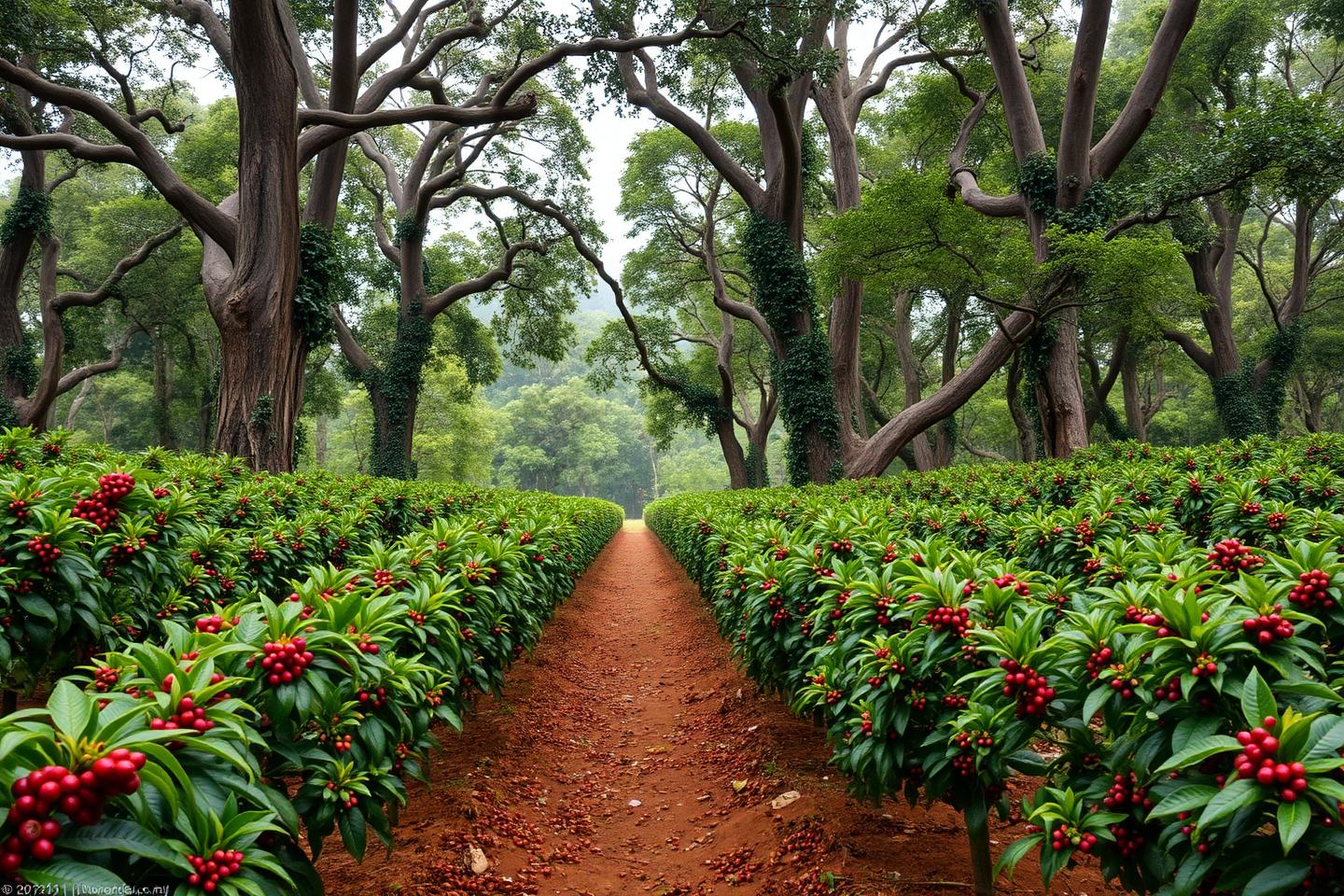
Coffee under shade trees, with pepper vines trained up the trunks.
Commissioned illustration for this project.
Illustrative image, not a historical photograph.
Crops
Wet rice in the valley bottoms was the food crop and the basis of Kodava land tenure and social standing. The agricultural year — transplanting, ripening, first harvest — still sets the dates of the two household festivals.
Grown under shade trees on the slopes. Planting expanded rapidly from about the 1850s under British administration, first by European planters and then widely by Kodava landowners; Kodagu remains one of India's leading coffee districts.
Trained up the shade trees of the coffee plantations, giving two harvests from the same ground and a second cash income keyed to a different market.
Sources & Further Reading
Grown in the wetter, higher forest margins. Historically a forest-collected and then cultivated spice, and one of the reasons the lowland trade routes mattered to the Haleri kingdom.
Coorg mandarin, wild honey, timber and minor forest produce filled out the district's economy and its export lists in the colonial gazetteers.
Because coffee is grown under native trees and villages retained sacred groves, Kodagu kept far more tree cover than most plantation districts — a pattern studied as an agroforestry system rather than simply as farming.
Sources & Further Reading
Note
Chronology
1850s – 1900s
DocumentedColonial planters and Kodava landholders convert forest and shola margins to coffee, restructuring land, labour and trade.